Key Takeaways
- Stable rankings with falling clicks is not a penalty. It is the AI Overviews traffic drop: Google now answers the question on the results page instead of sending the visitor to you.
- Pew Research found people click a search result on 8% of visits when an AI summary appears, against 15% when it does not. SparkToro put zero-click searches at 68% for early 2026.
- Two things are draining traffic at once — Google answering on its own page (the larger effect today) and people skipping Google for ChatGPT (smaller, growing fast).
- Local businesses are exposed in a specific way: AI Overviews show on 68% of local searches, the map pack on only 39%.
- Diagnose it in Google Search Console: impressions flat, position stable, clicks down. Fix it by answering questions directly, adding schema markup, keeping your Google Business Profile current, earning mentions on third-party sites, and measuring citations instead of sessions.
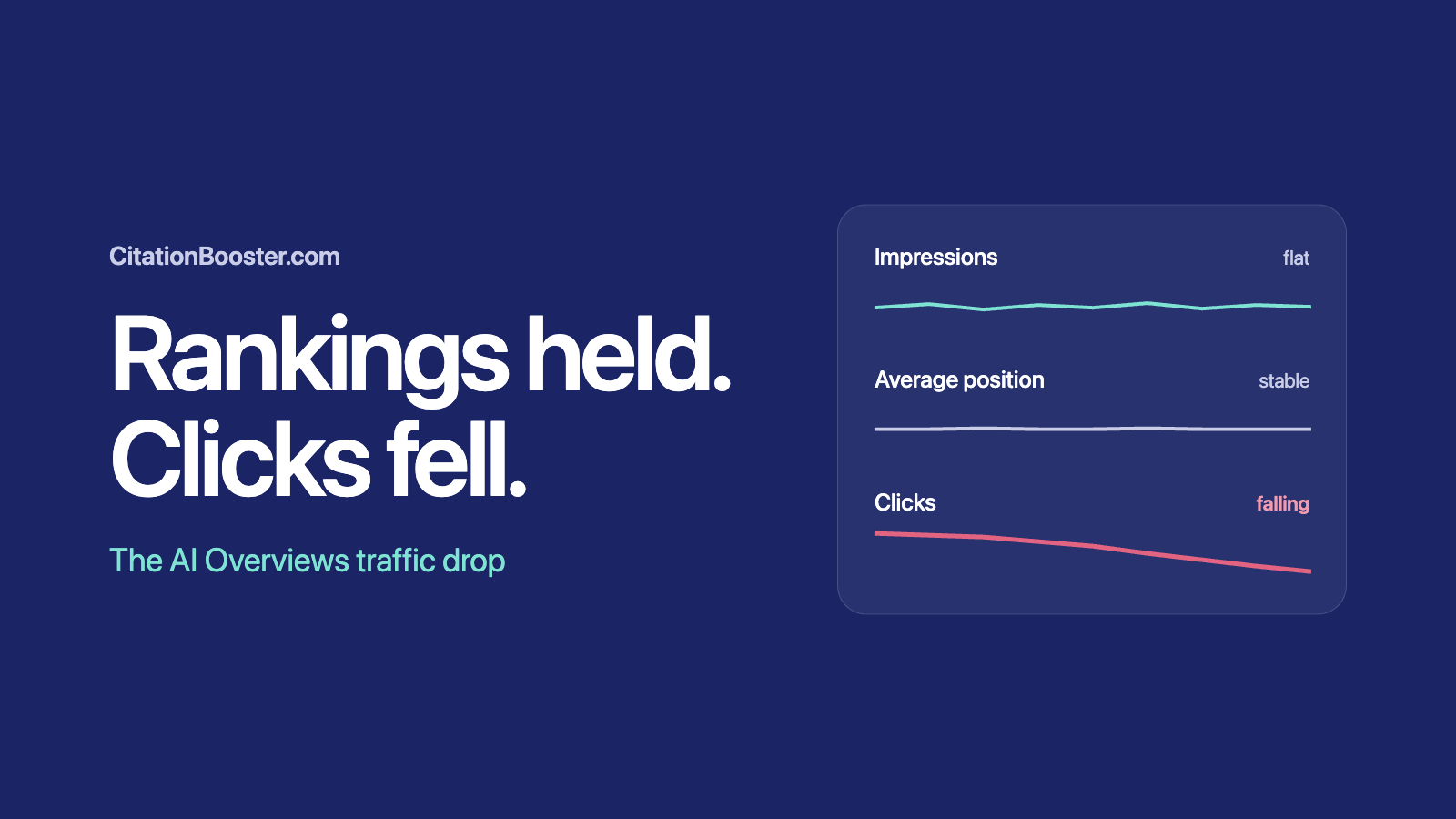
Your Google Search Console report says position 3. Impressions are flat. Clicks are down 40%. No penalty notice arrived, no site redesign shipped, and nothing on your end broke.
This pattern has a name. It is the AI Overviews traffic drop, and it is what happens when a search engine starts answering the question instead of routing the visitor to someone who can.
Here is what changed, how large the effect actually is, and what a small business can do about it.
What an AI Overview Actually Is
An AI Overview is a summary Google writes itself, assembled from several websites, and places on the results page. The person searching reads the answer there. Source links appear, but they are small and easy to skip.
Three terms are worth fixing in place first:
- SERP — the search engine results page, the page of results you see after hitting enter.
- CTR — click-through rate, the share of people who see your listing and click it.
- Zero-click search — a search that ends without the person visiting any website.
One detail most explanations miss: AI Overviews are not a fixed box at the top. They also appear mid-page, at the bottom, inside "People Also Ask" sections, and sometimes collapsed behind a click. Their presence varies query by query, which is part of why the impact is uneven across businesses.
How Large the AI Overviews Traffic Drop Really Is
The clearest measurement comes from the Pew Research Center, which analyzed 68,879 Google searches from 900 US adults who agreed to share their browsing data. When an AI summary appeared, people clicked a traditional search result on 8% of visits. Without a summary, they clicked on 15% — roughly twice as often. Links inside the summary itself were clicked on 1% of visits.
Broader clickstream data points the same direction. SparkToro's 2026 analysis found 68.01% of Google searches ended without a click between January and April 2026, up from 60.45% in 2024. BrightEdge data puts AI Overviews on roughly 48% of tracked queries.
Individual cases are sharper. In his O'Reilly book Answer Engine Optimization, Rodrigo Stockebrand documents HubSpot losing 70–80% of its organic traffic. He also records the Daily Mail's desktop CTR falling from 25.23% to 2.79% on queries that returned an AI Overview.
Size matters here, and not in your favor: small publishers have lost roughly 60% of their search referral traffic, against about 22% for large ones.
Rankings and Traffic Have Come Apart
For twenty years, the relationship was dependable. Rank higher, get more visitors. That link has weakened.
You can diagnose this yourself in Google Search Console. Open the Performance report, compare the last three months against the same period last year, and look at three numbers together:
- Impressions — flat or rising
- Average position — stable
- Clicks — falling
If that is the shape of your data, the searches are still happening and you are still being shown. The answer is simply being consumed before anyone reaches you. This is not a penalty, and no amount of conventional on-page cleanup will reverse it.
The Second Drain: Searches That Never Reach Google
Stockebrand describes two forces working at once, which he calls the great traffic redirect. The first is internal: Google answering on its own results page. The second is external: people skipping Google entirely for ChatGPT, Perplexity, Gemini, or Claude.
ChatGPT now has over 900 million weekly active users (February 2026). Research from NP Digital found 93.7% of ChatGPT searches are informational — definitions, how-tos, comparisons, the exact material most business blogs are built from. Among 18-to-24-year-olds, one study found 66% use ChatGPT to find information against 69% for Google.
Keep the proportions straight, though. For most sites, referral traffic from ChatGPT is still under 5% of the total, according to Grow & Convert's client data. The larger loss is still happening inside Google. The external shift matters because of its direction, not its current size.
There is a partial consolation. A Siege Media analysis found visitors arriving from ChatGPT engaged 1.73% more than those from organic search. They come with the question half-answered and a reason to be there.
Why Local and Small Businesses Feel It Differently
Local search has moved faster than most owners realize. A Whitespark study found AI Overviews appear for 68% of local searches, while the traditional local pack — the map with three business listings — appears for only 39% of the same queries.
The practical consequence: you can hold a strong position in the map pack and still be absent from the AI answer sitting above it. Two different systems, two different sets of signals, one results page. A restaurant or a clinic can rank well locally and still never be named when someone asks Google which one to choose.
The Measurement Problem Nobody Warns You About
The drop happening inside Google is at least visible in Search Console. The external shift often is not.
Someone asks ChatGPT for a recommendation, sees your business named, then types your brand into Google or walks into your shop. Your analytics records that as direct traffic, branded search, or nothing at all. The decision was made inside a conversation you cannot see.
Three proxies help:
- Branded search volume — if branded searches rise while generic ones stay flat, people are likely finding you through AI first.
- Direct traffic — unexplained increases often trace back to an AI recommendation.
- A "how did you hear about us" field — the cheapest instrument you have, and the only one that catches offline conversions.
What Actually Works Now
The practice that has grown up around this is called answer engine optimization, or AEO: structuring content so it gets retrieved and quoted inside an answer, rather than ranked and clicked. Six moves carry most of the weight.
Answer the question first. Put a direct, complete answer in the first two or three sentences under a heading shaped like a question. Retrieval systems pull passages, not pages. A buried answer does not get lifted.
Make your facts machine-readable. Add LocalBusiness or Organization schema markup. Schema is a small block of code that states your hours, location, and services in a form machines read without guessing. Keep your Google Business Profile current. Keep your name, address, and phone number identical everywhere they appear.
Collect and answer reviews. Recent reviews with owner responses are among the stronger signals for local citation.
Get mentioned somewhere other than your own site. In AI answers, breadth beats depth. Being named across Reddit threads, YouTube videos, directories, review sites, and press coverage does more than another page on your domain. Stockebrand's example is Vercel, whose visibility in AI answers is driven less by its own documentation than by the third-party posts repeating the same message.
Defend the queries that still convert. Local, branded, pricing, booking, and purchase-intent searches still send clicks. These deserve more attention now, not less.
Change what you report. Sessions alone will mislead you. Track citations in AI answers, branded search volume, and conversions per visit. A smaller, better-qualified audience is the realistic target.
Frequently Asked Questions
Is the AI Overviews traffic drop permanent?
The specific volume is unlikely to return. Zero-click rates have risen every year measured since 2016, and Google has continued expanding AI features. What is recoverable is visibility — being the source cited inside the answer.
Can I opt out of AI Overviews?
Only at a cost. Blocking Google-Extended won't do it — Google says it doesn't affect Search, and AI Overviews draw on the normal Search index. The real controls are nosnippet, data-nosnippet, max-snippet or noindex, and each also shrinks or removes your regular snippet. For most sites, being cited beats being absent.
Should I stop publishing blog content?
No, but change what you publish. Generic explainer content is the category hit hardest. Original data, firsthand experience, local specifics, and material no model can summarize from elsewhere still earn clicks.
How long before AEO changes show up?
Schema markup and Google Business Profile fixes can register within weeks. Third-party mentions and review depth take months.
The Bottom Line
Google still processes far more searches than every AI assistant combined, and traditional SEO still matters. But the results page no longer exists mainly to send you visitors. The AI Overviews traffic drop is the visible edge of that shift.
The businesses adapting fastest have stopped chasing their old click volume. They ask a narrower question instead: when an answer engine answers a question in our category, does it name us? That is a smaller target than page-one rankings, and a more reachable one.
Start with your Search Console diagnosis this week. If impressions held and clicks fell, you already know what you are dealing with.
To see which sources Google's AI Overview cites for your topic, and what to change on your page to become one of them, start with the lifetime deal.
Data sources: Pew Research Center (July 2025); SparkToro (2026); BrightEdge (2026); Whitespark local search study; NP Digital; Grow & Convert; Siege Media. Publisher case data and the "great traffic redirect" framing draw on Rodrigo Stockebrand, Answer Engine Optimization (O'Reilly)