Key Takeaways
- AI tools send small programs called "bots" to read websites, and only the bots that fetch a page while someone is asking can give you a citation in AI answers.
- Many AI bots can't see words that appear only after a page "fills in", so a beautiful website can look empty to them.
- On some midsize websites, ChatGPT's training bot made 15,000–20,000 visits a day against about 800 from Google, slowing the sites until live AI requests gave up.
- Labels for computers (called schema) appeared on 25% of the pages ChatGPT cited and 34% of the pages Google's AI Mode cited, per Answer Engine Optimization (O'Reilly, 2026).
- AirOps research says about 85% of how a brand shows up in AI answers depends on what other websites say about it.
Hi! Ever asked ChatGPT about your industry and wondered why your website never shows up? The reason often has nothing to do with your writing. A citation in AI answers starts behind the scenes, in parts of your website most people never see.
In Answer Engine Optimization (O'Reilly, 2026) the author tells the story of a software company that did everything "right": great articles, hundreds of weekly mentions and record Google traffic.
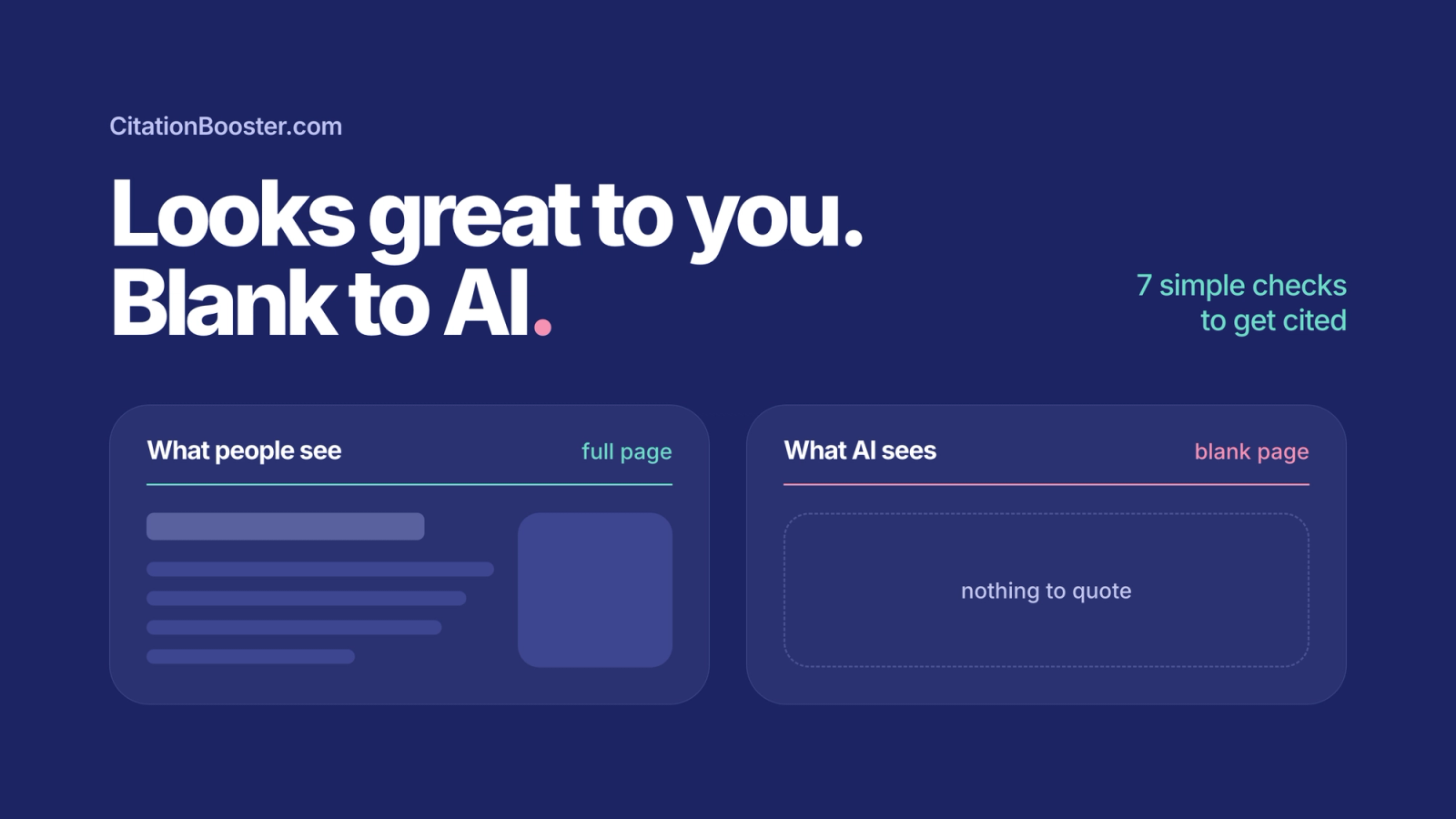
Yet ChatGPT and Perplexity barely knew it existed. To people the website looked perfect. To AI, it looked like a blank page.
You don't need to be technical to spot problems like that. Here are seven plain-English checks, plus what to ask your developer.
How does an AI tool decide which websites to cite?
An AI tool can only cite a website it can visit, read and load quickly. Tools like ChatGPT send out small automated programs, called bots or crawlers, to read the web. Think of them as three kinds of visitors:
- The librarian (training bots) reads everything to teach the AI for the future. Example: GPTBot from OpenAI.
- The catalog builder (search bots) keeps a list of pages, like a library catalog. Example: OAI-SearchBot.
- The errand runner (user bots) fetches your page the moment someone asks a question. Example: ChatGPT-User.
The errand runner is the one that puts your link in the answer.
Cloudflare's Radar Year in Review found that AI bots (not counting Google) made about 4.2% of all web page requests on Cloudflare's network. Google's own bot made about 4.5%.
Google Analytics hides bot visits by default. Your server logs, a diary of every visit kept by your web host, will show them.
Are you accidentally locking AI out of your website?
Your website may be locking AI out without you knowing, through a small file called robots.txt. robots.txt works like a sign on your front door saying who may come in. Almost every website has one: type www.yoursite.com/robots.txt into your browser and take a look.
| Approach | In plain words | Good for | Downside |
|---|---|---|---|
| Open door | Every bot is welcome | Being seen as widely as possible | AI companies learn from your content for free |
| Citation-first | Welcome the errand runners, turn away the librarians | Most businesses that want AI citations | Future AI versions may know less about you |
| Guest list | Only chosen bots allowed | Sites with paid or licensed content | Needs regular upkeep |
| Locked door | No AI bots at all | Paywalled publishers | You vanish from AI answers |
As of October 2026, citation-first is a sensible start for most businesses.
Two heads-ups: old website templates sometimes block every bot except Google's by accident. And the sign isn't a lock. Perplexity says its errand-runner bot ignores robots.txt, because a real person asked for the page.
Ask your developer: "Which AI bots does our robots.txt allow, and is that on purpose?"
Can AI actually see what's on your web pages?
AI often can't see your pages if the words only appear after the page fills in on screen. Many modern websites send an empty frame first, then add the text with code called JavaScript.
Your browser runs that code instantly. Most AI bots don't, so they see the empty frame and move on.
Picture a shop window that only lights up when a customer walks by. A bot walking past sees a dark window.
Here's a quick check that needs no tools:
- Open one of your articles in Chrome, Edge or Firefox.
- Right-click the page and choose "View page source."
- Press Ctrl+F (Cmd+F on a Mac) and search for a sentence from your article.
If you find the sentence, AI can probably read it. If you see only code, you've found a problem worth fixing.
AI also misses text inside images, pages behind a login or "I'm not a robot" check, and results that only appear after a click.
Ask your developer: "Is our main text in the page from the first moment it loads?" The usual fixes are called server-side rendering or a static site.
Why does website speed matter for AI citations?
Website speed matters because the AI errand runner has a person waiting, so it skips slow websites and cites a faster one. It usually waits only a few seconds.
The surprise culprit is often the librarian bots. The book reports midsize websites where OpenAI's training bot made 15,000–20,000 visits in one day, while Google's bot made about 800. That crowd can slow a site from 0.2 seconds to several seconds, so the errand runner can't get in fast enough and a competitor gets the citation.
Think of a café where a tour group grabs every table just as a regular walks in. The regular leaves.
Fixes your developer can make:
- Slow down the librarian bots so they can't crowd the site (called "rate limiting").
- Keep a fast lane open for the errand-runner bots.
- Aim for the site to start responding in under 0.2 seconds, with an alert if it goes past 0.5 seconds.
Do "labels for computers" help you get cited by AI?
Labels for computers, called schema markup, help AI understand who you are and what a page is about, but they don't guarantee a citation.
Schema is hidden information in your page. It works like labels on moving boxes ("kitchen", "books"), so a computer doesn't have to guess what's inside.
Data in Answer Engine Optimization (2026) shows these labels on many cited pages. Business labels appeared on 25% of the pages ChatGPT cited and 34% of the pages Google's AI Mode cited. Article labels appeared on 20% and 26%.
Three labels worth having:
- Who you are: business name, website, and links to your LinkedIn and other profiles.
- Who wrote it: the author, the publish date and the last-updated date.
- Where it sits: the path on your site, like Home › Blog › This article.
SEO plugins for WordPress and similar tools often add these labels for you, and Google's free Rich Results Test checks them. One honest note: labels help AI understand good content, but they can't rescue weak content.
How do you show AI your content is up to date?
You show AI your content is current by keeping every date on the page honest and consistent. When two pages say similar things, AI tools tend to pick the newer one.
A competitor's 2026 guide can push your 2019 guide out of the answer, even if yours is still correct.
Three simple habits:
- Show a "Last updated" date on your articles, and change it only when you really update the content.
- Refresh your most important pages every few months with current examples and numbers.
- Ask your developer to turn on IndexNow, a free "I've updated something" alert. Bing supports IndexNow, and Bing's index helps power ChatGPT Search, so your changes can reach ChatGPT faster.
Watch out for websites that stamp a new date on every page whenever the design changes; AI learns to distrust those dates. Curious how quickly search engines notice changes? Here's how long Google takes to crawl and index a page.
Should you add an llms.txt file to your website?
An llms.txt file is a cheap, easy step worth taking, even though it isn't an official standard yet as of October 2026. llms.txt is a short note at yoursite.com/llms.txt that tells AI tools what your website is about and which pages matter most. Think of it as a cover letter for AI.
A typical llms.txt is tiny: 1–5 KB, roughly one page of text. Don't expect miracles from it alone, but it only takes an hour in the afternoon for your developer.
What should you check first to get a citation in AI answers?
Check whether AI can get in first, then whether it can read your pages, then speed, then labels and dates. Here's a six-step list you can hand to your developer:
- Decide your AI bot policy (citation-first is a good default) and update robots.txt.
- Do the "View page source" test on your 10 most important pages.
- Check your server logs once a week for AI bot visits.
- Add business, author and page-path labels (schema).
- Keep "Last updated" dates honest and turn on IndexNow.
- Add a simple llms.txt file.
One last thing: these fixes make you findable, but they won't earn citations on their own. AirOps research, cited in the book, suggests about 85% of a brand's presence in AI answers comes from other websites: reviews, news coverage and online communities.
Already done all six and still not cited? Try CitationBooster.com's 6-step check for pages not cited in AI answers, then read why ChatGPT, Perplexity and Google cite different sources.
FAQ
Does blocking ChatGPT's training bot remove me from ChatGPT answers?
No. GPTBot (the librarian) only collects content to train future versions of ChatGPT. Different bots, ChatGPT-User and OAI-SearchBot, fetch pages for live answers. Blocking GPTBot keeps you citable today, but future ChatGPT versions may know less about your brand. Decide which matters more to you.
Do I need a developer to fix these things?
Not for everything. You can check robots.txt, do the "View page source" test, add "Last updated" dates and write an llms.txt file yourself. Fixing how pages load, slowing down bots and setting up IndexNow usually need a developer or a good plugin. Most of these are one-time jobs.
How do I know if AI bots visit my website?
Ask your web host or developer for your server logs, the record of every visit. Google Analytics won't show bots, because it filters them out by default. Look for names like GPTBot, ChatGPT-User, ClaudeBot and PerplexityBot. A weekly look shows which pages AI reads most.
Sources: Answer Engine Optimization, "Technical Implementations." O'Reilly Media, 2026; Cloudflare Radar, Year in Review; Perplexity crawler documentation; OpenAI, Overview of OpenAI Crawlers; AirOps research on offsite signals in AI answers; IndexNow protocol. https://www.indexnow.org; llms.txt proposal. https://llmstxt.org; Google Rich Results Test.