Key Takeaways
- To improve AI citations, content must clear all seven stages of the retrieval-augmented generation (RAG) pipeline; failing any single stage means no citation.
- Entering the candidate retrieval pool is the largest gate: it eliminates more than 99.9999% of the web before ranking starts.
- Brands are mentioned in AI answers roughly three times as often as they are cited with a link, according to Profound and BrightEdge analyses.
- AirOps research puts the influence of off-site signals on AI visibility at about 85%, so on-page work alone covers the smaller share.
- AI citations should be measured in fresh sessions with memory disabled, on at least two platforms, comparing which sources recur.
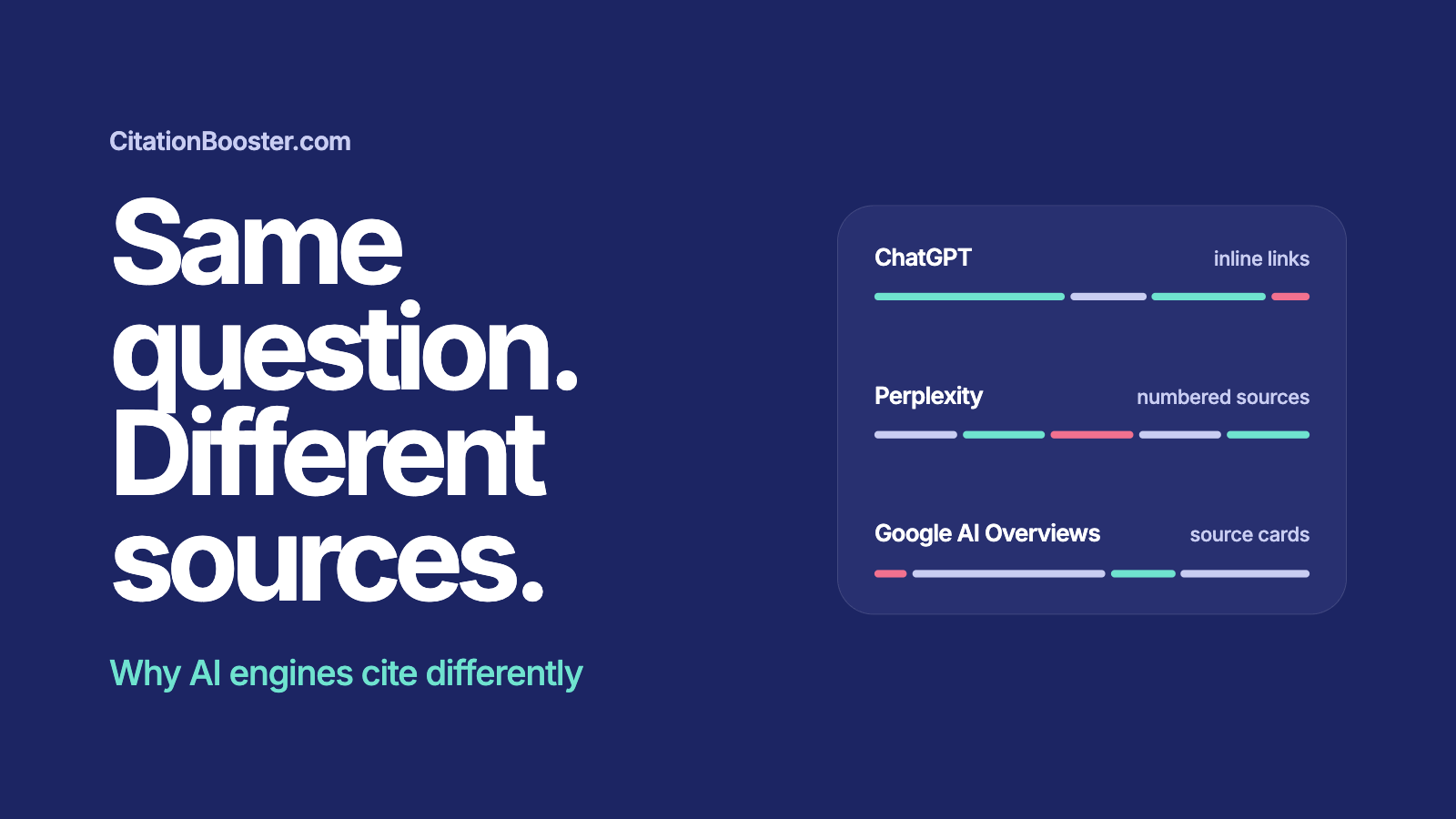
ChatGPT, Google AI Overviews, Perplexity, Claude and Microsoft Copilot all build answers from retrieved passages, yet each platform retrieves, ranks and cites in its own way. Rodrigo Stockebrand's Answer Engine Optimization (O'Reilly, 2026) models that process as a seven-stage pipeline supported by three strategic pillars. This guide condenses the model for marketing leads. Answer engine optimization (AEO) also goes by generative engine optimization (GEO) or AI SEO.
Why do ChatGPT, Perplexity and Google AI cite different sources for the same prompt?
Answer engines cite different sources because each platform relies on its own data sources, citation format and query handling. In one cross-platform test documented in Answer Engine Optimization(2026), a single prompt ("What's the best CRM for small businesses?") ran on five platforms within minutes and produced almost no overlap in cited sources. ChatGPT cited Zapier and G2, Perplexity cited TechRadar and PCMag, and Claude cited Gartner and Forrester.
| Platform | Main data sources | Citation style |
|---|---|---|
| Google AI Overviews | Google Search index, Knowledge Graph | Link cards, often collapsed |
| Perplexity | PerplexityBot, external APIs, real-time web | Sources shown first, inline numbers |
| Claude | ClaudeBot index, web search when enabled | Conversational inline attribution |
| Microsoft Copilot | Bing index, Microsoft Graph | Numbered footnotes |
Source: Answer Engine Optimization (O'Reilly, 2026), Table 2-1, as of July 2026.
Two consequences follow for marketing teams:
- Visibility does not carry over between platforms. A brand cited reliably on Perplexity can be missing entirely on ChatGPT.
- Organic rankings help but guarantee nothing. A page that ranks on backlinks can still miss out if its passages do not match the queries the engines generate.
What is the difference between an AI citation and an AI mention?
An AI citation is a linked source surfaced through live retrieval; an AI mention is a brand reference the model produces from training data, usually without a link. The two map to separate channels: retrieval and parametric knowledge. Parametric knowledge is whatever the model absorbed during training, and it stays fixed until the next training cycle.
Industry analyses from Profound and BrightEdge estimate that brands are mentioned roughly three times as often as they are cited with a link. Their methodologies differ, so the 3:1 ratio is best read as a direction, not a precise figure.
| Channel | Source of the answer | Main levers | Time to impact |
|---|---|---|---|
| Retrieval | Live or cached web index | Passage quality, freshness, crawler access | Days to weeks |
| Parametric | Model training data | Consistent brand descriptions, Wikipedia, digital PR | Months |
- If the goal is citations for specific prompts this quarter, focus on the retrieval channel.
- If AI answers describe the brand inaccurately (outdated positioning, old PR issues, confusion with a similar name), focus on the parametric channel.
How does the RAG pipeline decide which pages get cited?
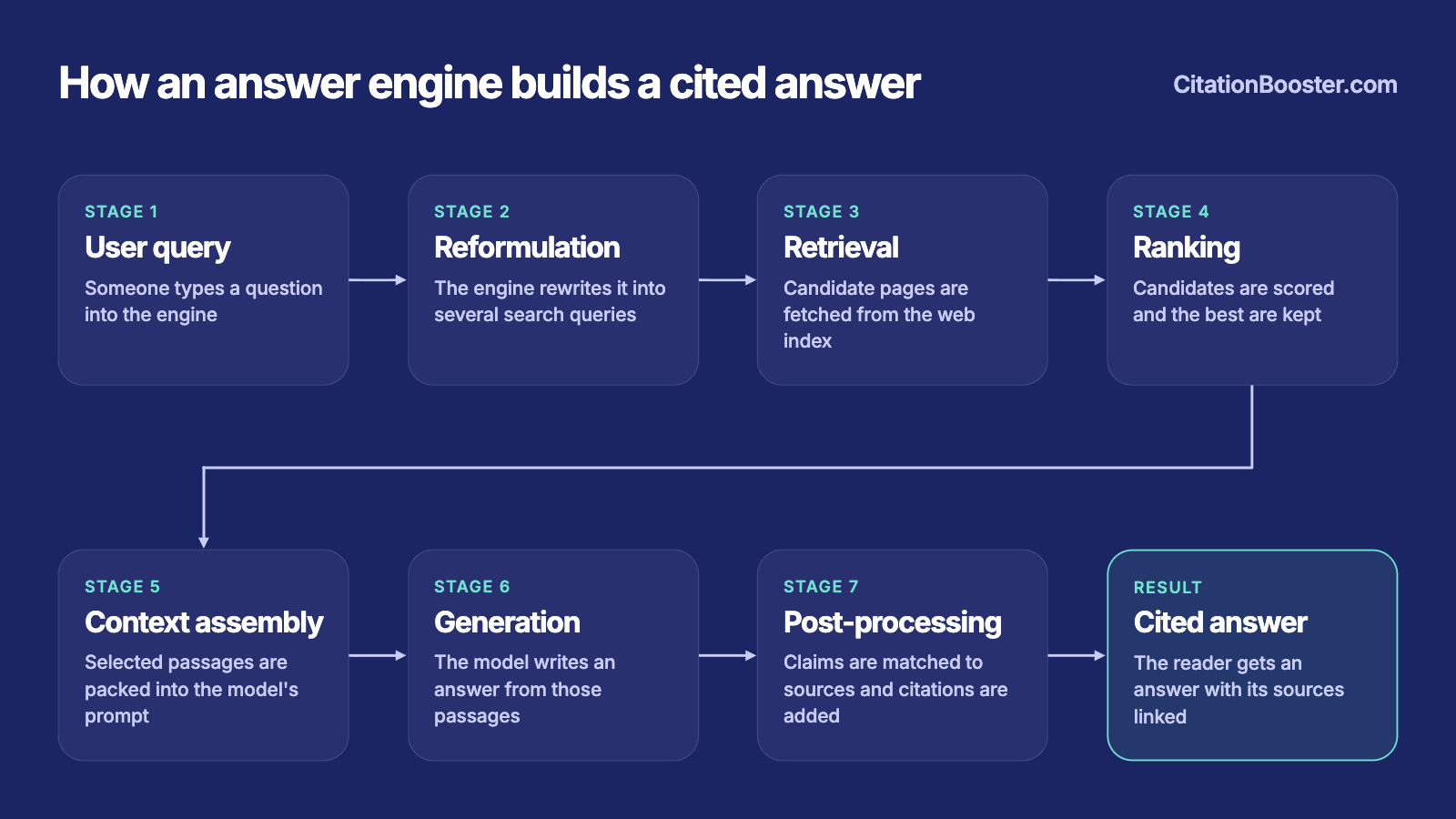
The RAG pipeline decides citations through seven sequential stages, and content has to clear every one of them. Retrieval-augmented generation (RAG) is the method answer engines use to fetch current documents and insert them into the model's prompt before it writes. The seven stages, as laid out in Answer Engine Optimization (2026):
- User query: the raw prompt arrives, often vague or misspelled.
- Query reformulation: the system classifies intent, extracts entities and rewrites the prompt into several queries (query fan-out).
- Retrieval: semantic vector search and keyword search (BM25) return dozens to hundreds of candidate passages.
- Ranking and reranking: models score candidates on relevance, authority and freshness.
- Context assembly: the top passages are selected, deduplicated and packaged.
- Generation: the model writes the answer and chooses which sources to cite.
- Post-processing: safety filters and grounding checks test claims against the sources.
A useful mental model is a relay race: a passage dropped at any handoff earns no citation, however strong it is at the other stages.
Not every prompt triggers the pipeline. Simple factual prompts such as "how many feet are in a mile" are answered straight from training data. Optimization effort pays off on complex, commercial and time-sensitive prompts, the so-called "deep path."
Why is the candidate retrieval pool the biggest gate for AI citations?
The candidate retrieval pool is the biggest gate because entering it eliminates more than 99.9999% of the web before ranking begins, according to Stockebrand (2026). A page outside the pool never reaches ranking, generation or citation.
Candidate selection is also shallower than most teams expect. Typical retrieval calls, including Bing's and Google's search APIs, return just five fields: title, URL, publication date, modification date and meta description. The system picks which pages to fetch from those fields alone. A title like "Clutch | Best Design Agencies in Seattle, Updated March 2026" carries far more selection weight than a generic "Our Services."
Three implications for marketing teams:
- Metadata is retrieval input. Titles and meta descriptions should state topic, qualifier and, where relevant, date.
- Traditional ranking still feeds selection. Kevin Indig's Growth Memo analysis (March 2026) indicates that well-ranked pages enter the pool more often.
- Indexation now spans several bots. Googlebot, OAI-SearchBot, PerplexityBot and ClaudeBot each keep separate indexes. Content a platform's crawler cannot reach cannot be retrieved on that platform.
How should marketing teams write content that answer engines quote?
Content that answer engines quote is written at the passage level: each section answers one question in its opening sentences and stands on its own. Engines split pages into overlapping chunks and score each chunk separately. Google's Vertex AI RAG documentation lists defaults of 1,024 tokens per chunk with 256 tokens of overlap, about 25%.
Two findings favor putting the answer first, a practice known as bottom line up front (BLUF):
- At context assembly, a system sometimes uses only one passage, often the shortest and most direct.
- The "Lost in the Middle" study by Liu et al. (2023) found that language models use information at the start and end of long contexts more reliably than information in the middle.
Writing rules that follow:
- Open each section with a sentence that names the subject and answers the heading.
- Keep one idea per section; skip openers such as "As mentioned above."
- Match the wording of fan-out queries, not only what users type. These are often long-tail phrasings people rarely search for directly.
- Add explicit dates and refresh content with current data, since retrieval systems read timestamps as freshness signals.
- Back claims with named sources, because post-processing checks claims against the retrieved material.
Which three pillars of the AEO framework improve AI citations?
The AEO framework rests on three pillars: technical foundation, content optimization, and brand and entity management. The pillars act as one system, so weakness in one caps the effect of the other two.
| Pillar | What it covers | Why it affects citations |
|---|---|---|
| Technical foundation | Passage-level writing, query alignment, freshness | Decides whether passages survive ranking and generation |
| Brand and entity management | Wikipedia and Wikidata, consistent entity data, digital PR, reviews | Shapes parametric memory and consensus signals |
The third pillar carries the most weight in the available data. AirOps research puts the influence of off-site signals on AI visibility at about 85%. Teams focused mainly on technical SEO and on-page edits are working on the smaller share.
Consistency sits in the same pillar. Agreement across sources works as a consensus filter: when independent sources agree, engines cite with confidence. When product descriptions conflict across the website, press releases, Wikipedia and reviews, engines hedge or drop the sources altogether. For agency and B2B service queries, AirOps and practitioner studies point to Clutch reviews as a disproportionately preferred source.
How is AEO different from SEO for marketing KPIs?
AEO differs from SEO mainly in its goal: SEO aims to rank a page, while AEO aims to earn a citation or mention inside a generated answer. The comparison in Answer Engine Optimization (2026) spans ten dimensions; four matter most for reporting:
| Dimension | Traditional SEO | AEO |
|---|---|---|
| Success metric | Rankings, organic CTR | Citations, mentions, brand accuracy |
| User journey | Click through to the site | Answer often read without a click |
| Time to impact | Days to weeks | Retrieval: days to weeks; parametric: months |
| Content unit | Page | Passage within a page |
Organic CTR therefore understates AEO impact. Better indicators are brand visibility, accurate representation and citation frequency on the platforms the audience actually uses. One content format calls for caution: listicle pages now receive less citation weight in Google AI Overviews than they once did.
How should marketing teams measure AI citations?
Marketing teams should measure AI citations by running the same prompts across several fresh sessions, with memory disabled, on at least two platforms, and comparing which sources recur. Four factors cause answers to vary between runs: sampling temperature, shifting retrieval results, model updates and personalization.
A repeatable setup:
- Build a prompt set from persona questions, covering informational, comparison and navigational intents.
- Run each prompt in a fresh session with memory off.
- Repeat on the platforms the audience uses.
- Log citations (linked sources) and mentions (unlinked brand references) separately.
- Compare patterns across sessions; a single test in a single session reveals very little.
To observe query fan-out, Bing Webmaster Tools lists generated queries from Bing-backed engines, including ChatGPT and Copilot. Google Search Console does not report AI Mode queries, but regex filters for long natural-language queries can approximate them.
Manual logging scales poorly: 20 prompts on 5 platforms in 3 sessions already produce 300 answers to record.
What should a marketing team fix first to improve AI citations?
The first fix depends on the pipeline stage where content currently fails. Practitioners only see the outcome, cited or not cited, so the seven stages work best as a diagnostic map.
- If the site appears in no platform's answers for core prompts, check crawler access and indexation first.
- If pages rank in Google but are not cited, rewrite key sections answer-first and sharpen titles and meta descriptions.
- If the brand is mentioned but described inaccurately, align its description across the website, press releases, Wikipedia, Wikidata, directories and review sites.
- If competitors are cited through third-party sources, prioritize digital PR and presence on the review and media sites that dominate the category.
- If content is accurate but dated, refresh it with current data and explicit dates.
Retrieval-side changes can show up within days to weeks. Parametric changes take effect only after retraining, which happens every few months at best. Reporting windows should reflect both timelines, and a tracking setup such as Citation Booster can separate the two channels over time.
FAQ
Can a brand get cited by AI if it ranks poorly in Google?
A brand can be cited without top Google rankings, but it is harder. Traditional ranking still feeds candidate selection, so well-ranked pages enter the retrieval pool more often. ChatGPT and Copilot rely on Bing's index, and Perplexity runs its own crawler, so they can surface pages Google ranks lower. A passage that directly answers a long-tail fan-out query can also earn a citation.
Does schema markup improve AI citations?
Schema markup supports AI citations indirectly. Structured data belongs to the technical foundation pillar because it helps answer engines resolve ambiguity about entities, products and relationships. Schema does not earn citations on its own; passages still need to match reformulated queries and survive ranking. Treat it as an entity-clarity aid, not a shortcut.
How long does it take to improve AI citations?
Retrieval-based citations can change within days to weeks, because RAG systems fetch current documents at query time. Content published on a Tuesday night can be cited by Wednesday morning, according to Stockebrand (2026). Changes to parametric memory, meaning how a model describes a brand without searching, take months because they depend on the next training cycle.
Sources: Liu, Nelson F., et al. "Lost in the Middle: How Language Models Use Long Contexts." arXiv, 2023; Indig, Kevin. "The Science of How AI Picks Its Sources." Growth Memo, March 23, 2026; Stockebrand, Rodrigo. Answer Engine Optimization, O'Reilly Media, 2026. ISBN 979-8-341-67255-0; AirOps. Research on off-site signals in AI search; Techmagnate: Analyses of brand mentions versus citations in AI answers; Google Cloud. Vertex AI RAG documentation, chunking defaults.